What is money anyway?
- Money does three jobs: it pays for things, it measures what things are worth, and it carries value into the future.
- Aristotle spotted the third job more than 2,300 years ago: money as a guarantee you can get what you need later.
- Today's money is good at the first two. The third, the future, is where it quietly struggles.
You use money every day and probably never stop to ask what it is. Fair enough: it pays the rent, it tells you a coffee costs $5, and it works. But money has a third job, and it's the one that decides what your work is still worth in ten years.
The three jobs
Economists call these a medium of exchange, a unit of account, and a store of value. You don't need the jargon. You just need to notice that the first two happen instantly, and the third takes time.
Money is stored time
Think about where your money comes from. You trade hours of your life for it. Money is a way to keep the value of that work, and the time it took, and carry it into the future until you need it.
Let's make it concrete
Noah works three weekends at a café and earns $300. He puts it aside for a laptop he'll buy later.
Three years go by. Prices rise 3% a year, so what cost $300 back then now costs about $328. Noah's $300 still stands for the same three weekends of work. But it now buys what about $275 bought when he earned it.
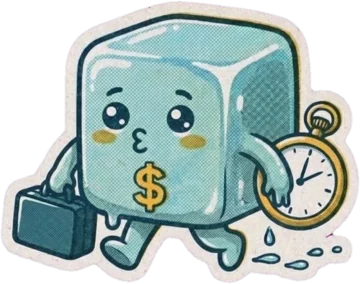
His work didn't shrink. What it can buy did. Paying still works: any shop takes his $300. Measuring still works: he can see exactly what the laptop costs. It's the waiting that cost him.
Aristotle saw it first
More than 2,300 years ago, in the Nicomachean Ethics, Aristotle wrote that money serves future exchange: "if we do not need a thing now we shall have it if ever we do need it." For that, he said, "money is as it were our surety." A surety is a guarantee.
The neat list of three jobs came much later, in the 19th century, and it simplifies things. But Aristotle had already put his finger on the job that matters most for your savings: money is a promise about the future.
Money that has value because a government declares it legal tender and people trust it, not because you can exchange it for gold. In practice, every major currency has worked this way since the early 1970s.
So why does the third job fail?
Not by accident. Today's money is so-called fiat money: there's no gold behind it, and its value is managed by central banks, through interest rates and how much new money gets created. Their policies decide how fast prices rise.
Most central banks aim for prices to rise about 2% a year, on purpose, to keep the economy moving. That makes money good at paying and measuring today, and slowly worse at carrying value into the future. The promise Aristotle described still holds, just a little less every year.